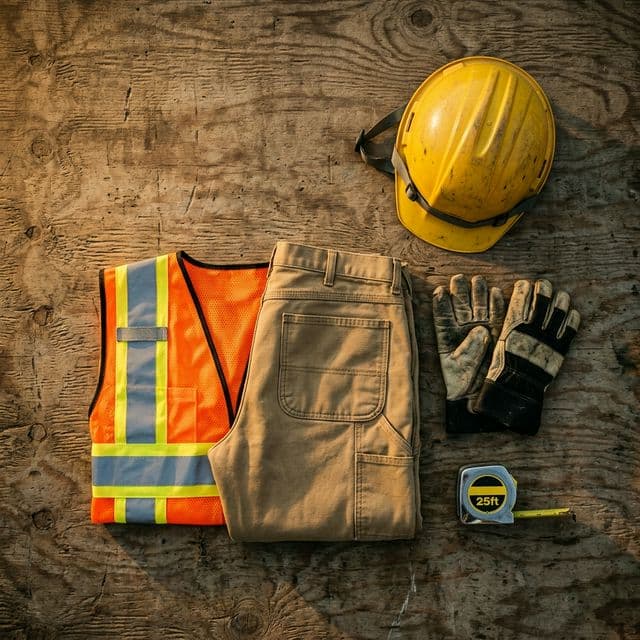
The Complete Guide to Construction Workwear & Job Site Uniforms
Construction is the hardest environment for workwear. Between concrete dust, rebar snags, UV exposure, and the physical demands of framing, masonry, and electrical work, most retail clothing doesn't survive a single week on a job site.
This guide covers how to choose workwear that holds up to the abuse — and how factory irregulars let you outfit an entire crew without overspending.
What Makes Construction Workwear Different
The job site puts clothing through a unique combination of stressors:
- Abrasion — kneeling on concrete, brushing against rough lumber, dragging across rebar
- UV exposure — full-day sun exposure breaks down cheap fabrics fast
- Range of motion — overhead reaching, squatting, climbing ladders
- Chemical contact — concrete dust, sealants, adhesives, wood stains
- Temperature extremes — summer heat on asphalt, winter wind on open frames
Standard retail clothing fails on all counts. Industrial brands like Red Kap and Dickies engineer construction-grade workwear with reinforced seams, heavy-duty fabrics, and cuts designed for physical labor.
Work Pants: The Most Important Piece
What to Prioritize
Your pants take the worst beating on any job site. Here's what matters:
- Triple-stitched seams at inseam, seat, and knee — single-stitch pants blow out within weeks
- Heavy-duty fabric — minimum 7.5 oz twill or duck canvas
- Reinforced knees — you're kneeling on concrete, gravel, and plywood daily
- Functional pockets — carpenter-style with hammer loops, tape measure clips, and tool pockets
- Soil-release finish — concrete dust and drywall mud wash out in a standard cycle
Red Kap Industrial Pants (PT20/PT62)
The standard for construction crews. Plain-front or pleated, available in waist sizes 28–54. The fabric is treated with a soil-release finish that handles concrete dust, joint compound, and light grease without pre-treatment.
Dickies Work Pants (874/WP592)
The legendary 874 originated on construction sites. Heavy-weight twill with a permanent crease that holds up through dozens of washes. The WP592 cargo variant adds utility pockets without the bulk.
[!TIP] Buy two sets of work pants — one "clean" pair for client meetings and inspections, one beat-up pair for demo days and concrete work. Factory irregulars make this affordable since you're paying 40–60% less per pair.
Work Shirts: Layering for the Season
Summer: Short-Sleeve Crew Shirts
For hot-weather framing, roofing, or site work, you need a shirt that breathes and wicks moisture. Red Kap's ripstop crew shirts (SY60/SY80) are built for this — they prevent small tears from spreading when you catch a nail head or bracket edge.
Winter: Long-Sleeve Button-Downs + Layering
Cold-weather construction means layering. Start with a long-sleeve industrial work shirt, add a thermal mid-layer, and top with an insulated jacket. Red Kap long-sleeve shirts give you:
- Collar protection against sun and wind
- Roll-up sleeve tabs for warmer moments
- Chest pockets for pens, levels, and phones
Hi-Vis Options
Many GCs and commercial sites require ANSI-compliant hi-vis apparel. If your job site mandates it, look for Class 2 or Class 3 hi-vis shirts and vests rated to ANSI/ISEA 107.
[!IMPORTANT] All Red Kap work shirts, whether sold as "standard" or "irregular," use the same size patterns and templates. An irregular shirt fits identically to a retail one — the only difference is a minor cosmetic variation. Learn more about what "irregular" means →
Coveralls: Full-Body Protection for Demo & Concrete
For demolition, concrete pours, painting, and insulation work, coveralls keep your base clothes protected and provide full-body coverage.
When to Use Coveralls vs. Separates
| Use Case | Best Choice |
|---|---|
| Framing, finish carpentry | Shirt + pants |
| Concrete pour, masonry | Coveralls |
| Painting, staining, sealant work | Coveralls |
| Client walk-throughs, inspections | Shirt + pants |
| Welding, cutting, torch work | FR-rated coveralls |
| Insulation, demo, dusty environments | Coveralls |
Red Kap Twill Action Back Coveralls (CT10)
The standard for construction. Action-back pleated shoulders let you reach overhead without restriction. Two-way front zipper for convenience. Available in sizes S–5XL.
Flame-Resistant (FR) Gear for Welding & Cutting
If your crew does any welding, torch cutting, brazing, or works near open flames or arc flash hazards, FR-rated clothing is an OSHA requirement — not optional.
Bulwark FR is the industry standard:
- Nomex IIIA shirts and pants for welding stations and cutting areas
- FR coveralls for full-body protection during hot work
- All garments meet NFPA 2112 and ASTM F1506 standards
[!NOTE] FR workwear must never be washed with bleach or fabric softener — both degrade the flame-resistant properties. Always follow the care label instructions. Read our full Bulwark FR safety guide →
Outerwear: Year-Round Job Site Protection
Insulated Jackets
For winter framing and outdoor work, look for:
- Quilted thermal lining (not thin fleece)
- Water-resistant shell (you will get caught in rain)
- Reinforced elbows (you lean on everything on a job site)
- Red Kap and Dickies both offer industrial-grade insulated jackets in our inventory
Rain Gear
Separate rain suits (jacket + pants) are better than all-in-one ponchos for construction because you need full leg coverage and range of motion while carrying materials.
Browse our full jacket and outerwear inventory →
How to Outfit a Construction Crew on a Budget
Here's the typical math for a 10-person crew:
- 10 pants per worker (5 per week × 2-week laundry rotation) = 100 pants
- 10 shirts per worker = 100 shirts
- 2 coveralls per worker (for demo/concrete days) = 20 coveralls
- 1 jacket per worker = 10 jackets
At retail, that's easily $5,000–$7,000 for pants alone. With factory irregulars, you're looking at $2,000–$3,000 for the same Red Kap or Dickies pants — same fabric, same construction, same durability.
For a full crew of 10, irregulars can save you $3,000–$5,000 on the initial outfitting. That's real money back in the project budget.
Request a bulk quote for your crew →
Sizing Tips for Construction Workers
Construction workwear should fit differently than street clothes:
- Pants: Measure at your natural waist, not your hips. Add 1" to inseam if you wear tall work boots. Go up one waist size if you wear a loaded tool belt.
- Shirts: Order your normal size, but go one size up if you layer a thermal underneath. Red Kap's "Action Back" design already builds in room.
- Coveralls: Order one full size above your shirt size for layering. Two sizes up if you're wearing a hoodie underneath in winter.
For detailed measurements, see our Red Kap Sizing Guide →.
Summary
The right construction workwear keeps your crew productive, protected, and professional on every job site. Whether you're a one-truck contractor or a 50-person GC, the formula is:
- Heavy-duty work pants with reinforced knees and carpenter pockets
- Industrial work shirts in seasonal weights (short-sleeve summer / long-sleeve winter)
- Coveralls for demo, concrete, and messy jobs
- Bulwark FR for any hot work (welding, cutting, torch)
- Factory irregulars to cut costs without cutting quality
Need help outfitting your crew? Request a bulk quote → or contact us directly →.
Written By
Liliana Expert Team
Industrial Specialist